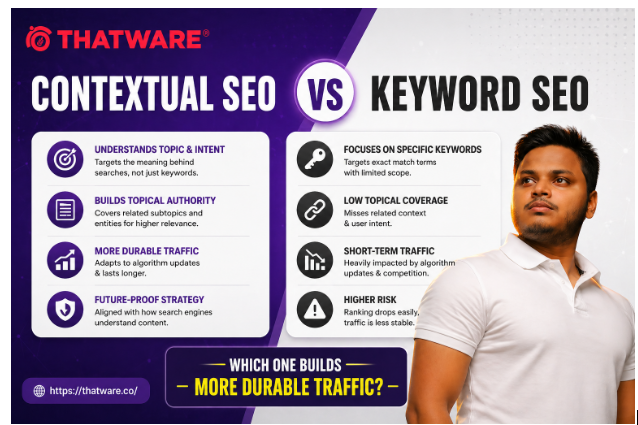

The debate between keyword SEO and contextual SEO sometimes gets framed as old-school versus new-school – a generational divide between practitioners who built their skills on keyword research and those who came up in the era of semantic search and topical authority. That framing, while tidy, misses the more interesting and practically useful version of the question.
Both approaches work. The real question is which one works longer and which one requires less constant reinvestment to maintain. And on that question, the evidence is increasingly clear.
What Keyword SEO Actually Does Well
It’s worth being honest about why keyword SEO became dominant and stayed dominant for as long as it did. It works. Identifying high-volume, achievable keywords and producing well-optimized content around them produces rankings. For many sites, that process has generated enormous organic traffic growth over the years.
The limitations only become apparent over time. Keyword-targeted content ages. The query landscape evolves. New competitors enter with fresher content. Algorithms update their weighting of topical depth vs. keyword presence. Traffic earned through keyword optimization often requires continuous reinvestment – new content, link building, refreshes – just to maintain. Remove the investment and rankings drift.
How Contextual SEO Builds Differently
Contextual seo services build from a different starting point: not “what keyword should I target?” but “what is this brand genuinely authoritative about, and how do I build a web presence that communicates that authority comprehensively?” The resulting content strategy tends to produce a denser, more interconnected content architecture where individual pages reinforce each other’s authority rather than competing for similar keyword territory.
The traffic build is usually slower. Contextual content earns its rankings more gradually because search engines are evaluating a broader set of signals – entity associations, topical coverage depth, internal link architecture, semantic relevance to adjacent topics – rather than just how well the page targets a specific phrase.
But the traffic, once earned, tends to be more durable. Contextual authority is harder for competitors to copy quickly and harder for algorithm updates to dislodge.
A Direct Comparison: What the Traffic Curves Actually Look Like
For a brand producing primarily keyword-targeted content, the typical traffic curve looks like a series of spikes and plateaus. A new piece of content ranks, drives traffic for 3-6 months while it’s relatively fresh and before competitors respond, then either holds or dips depending on competitive pressure and reinvestment.
For a brand building contextual depth, the traffic curve looks different. Slower to start. Often frustratingly slow in the first 6-12 months, especially if the brand has been producing keyword-focused content and is transitioning strategies. But after that initial period, the curve tends to be more consistently upward and significantly more stable around algorithm updates.
What Semantic SEO Services Look Like at the Execution Level
Semantic seo services involve more upfront strategy work than keyword SEO does. The process typically starts with topic cluster mapping – defining the full semantic space a brand wants to own, not just the specific queries it wants to rank for. That mapping exercise surfaces gaps and priorities in a way that keyword research alone doesn’t.
Content briefs based on that map are more complex. They specify not just the topic but its relationship to adjacent topics, the questions that arise at each stage of understanding, and the internal linking architecture that connects it to the broader content ecosystem. That specificity produces better content and better-performing pages.
The Honest Answer on Durability
Three to four years of consistent contextual content investment tends to produce a qualitatively different kind of search presence than the same investment in keyword-first content. Not just “more traffic” but a more defensible position – one where the brand’s presence is embedded in how search engines understand a topic, not just how well they’ve matched a specific page to a specific query.
For brands with a long enough planning horizon, that kind of durability justifies the slower initial build. For brands that need quick results on a short timeline, keyword SEO still delivers. The choice, honestly, is about time preference as much as strategy.